Choose a power bank that supplies the charging mode and output your device needs, holds enough energy for your time away from an outlet, and is light enough that you will carry it. Compare watt-hours, per-port output and input power. The largest mAh number does not automatically mean the best choice—or a predictable number of phone recharges.
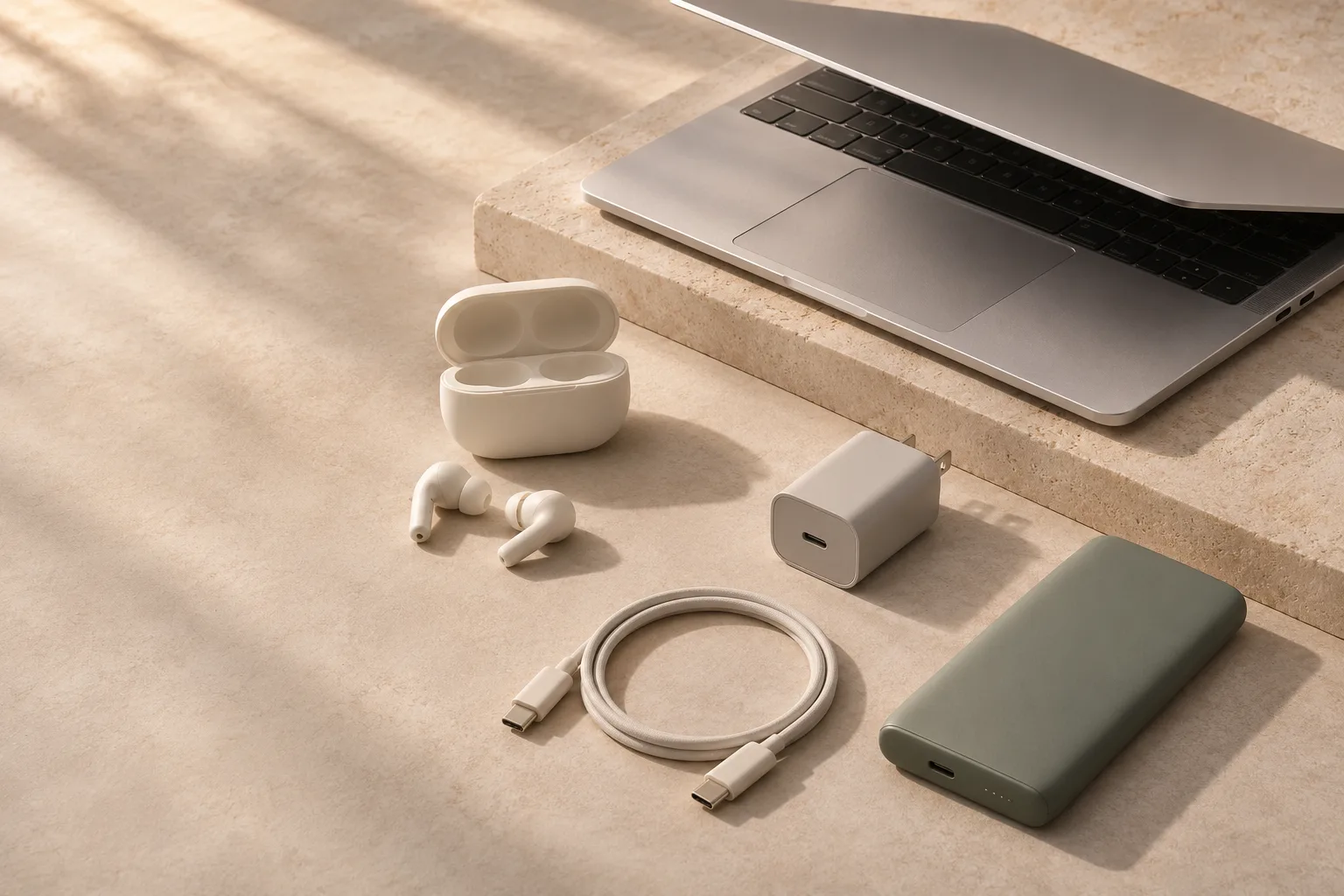
- Capacity, output and refill speed are different things.
- Use watt-hours to compare stored energy.
- Buy for the bag you carry, not the longest hypothetical trip.
Buy for the gap between outlets
Start by noticing when your battery actually runs low. A small top-up on the commute is different from keeping maps, a camera and messaging available through a long travel day. For a laptop, the task is different again: you need both sufficient energy and a charging output the laptop accepts.
| Your situation | What deserves priority | What can go wrong |
|---|---|---|
| A phone top-up during the day | Low weight, pocketable shape, a cable you carry | A large bank left at home is no help |
| Long days away from outlets | More usable energy and a practical refill time | Capacity without enough output can charge too slowly |
| Charging a laptop | Compatible USB PD output and enough watt-hours | A large phone bank may still be unable to power the laptop properly |
| Air travel | Readable Wh label and your airline’s current policy | A general capacity claim does not establish acceptance on every flight |
Common capacity classes such as 5,000, 10,000 and 20,000 mAh can help you organize a shortlist, but check the actual dimensions and weight. Two banks with the same headline capacity can be quite different to carry.
Capacity is stored energy, not a recharge count
Milliamp-hours (mAh) describe charge capacity at a particular voltage. Comparing those numbers across batteries at different voltages can mislead. Watt-hours (Wh) combine capacity and voltage, making stored energy easier to compare: Wh = mAh × nominal voltage ÷ 1,000. The FAA uses this calculation in its battery guidance. [1]
Voltage conversion, charging losses and the phone’s own power use reduce what reaches its battery. A phone navigating or recording video while plugged in consumes some of that energy immediately. Battery age, temperature and charging method can change the outcome further.
If a manufacturer provides a rated output capacity, read the voltage and test conditions attached to it. Do not compare that figure directly with a different bank’s internal-cell mAh rating. Prefer transparent specifications and comparable independent measurements over an unexplained “charges your phone five times” claim.
Check output before paying for more capacity
A bank can hold plenty of energy and still charge your device slowly. Read the output specification for the exact port: its USB Power Delivery (PD) support, any required Programmable Power Supply (PPS) capability and the power available when multiple ports are occupied. The same protocol and cable checks apply as when choosing a USB-C wall charger.
For a laptop, check the manufacturer’s recommended charging input rather than guessing from the connector. If the power bank delivers less than the laptop consumes during work, the battery may continue to drain even while connected. Some devices also reject charging sources that do not offer the required profile.
Distinguish a port marked input from one marked output; some do both. An integrated cable is convenient but can be a weak point if it cannot be replaced. A separate output port gives you another route if that cable fails.
For earbuds, watches and other low-power devices, look for explicit compatibility or a low-current mode. For wireless charging, verify the exact phone and case combination. Magnetic attachment alone does not prove a particular wireless charging standard or speed.
Remember that the power bank needs charging too
Input power tells you how quickly the bank can receive energy. A high output rating does not guarantee fast refilling. Check the required wall charger and cable, especially if you want to refill overnight before another full day out.
As a rough lower bound, a 37 Wh bank receiving a constant 20 W would need 37 ÷ 20, or about 1.85 hours. Real charging takes longer because power is not constant and losses occur. Use a manufacturer’s properly specified refill figure or a measured review for a more realistic expectation; the calculation only helps spot implausible claims.
Pass-through charging—charging a device while the bank itself is charging—is not universal. Even when supported, the power allocation and operating limits matter. Do not assume the bank can act as an uninterrupted power supply for equipment just because it can charge a phone while plugged in.
Finally, compare carrying weight with the cable included. If your real need is one emergency top-up, reducing weight may be worth more than doubling capacity. A bank for a handbag, a jacket pocket and a laptop backpack need not be the same size.
Check travel rules and the product’s provenance
For US-regulated flights, FAA guidance treats power banks as spare lithium batteries: they belong in carry-on baggage, with terminals protected. Its general guidance allows up to 100 Wh; larger batteries up to 160 Wh require airline approval and have additional limits. Airlines and other jurisdictions can be stricter, including on quantity, onboard use and storage. Check the operating airline before you buy for a trip and again before you fly. [1]
Choose a bank with a readable Wh label, an identifiable manufacturer and a seller that handles warranty claims. Check current recall information for the exact model. Avoid choosing solely by an unusually large capacity claim in a very small or very cheap package.
Follow the manufacturer’s storage and charging instructions. Stop using a swollen, damaged or recalled bank; arrange suitable local battery disposal instead of putting it in household waste. A warranty and a clear replacement process are useful ownership features, not just paperwork.
The five checks that make the purchase simpler
- Energy: Is the Wh rating clear, and is the expected usable energy enough for your day?
- Output: Does the intended port support your device’s charging protocol and power?
- Input: Can you refill the bank in the time you have, using the charger you own?
- Portability: Will you carry its actual weight and size, including the cable?
- Ownership: Are the seller, warranty, travel label and recall information easy to verify?
When two options meet those checks, choose the one that is easier to live with. Extra capacity is valuable when you use it; otherwise it is simply extra weight.
CHECK THE DETAILS
Sources & further reading
Primary sources checked on 14 November 2026. Product support and travel rules can change; verify details for the exact model or journey.
- Federal Aviation Administration — airline passengers and batteries ↗
Wh calculation and US passenger battery guidance. Airline policies must be checked separately.
- USB-IF — USB Power Delivery overview ↗
Background on compatible charging and negotiated power.
This is a research-based buying guide, not a hands-on product test. There are no affiliate links in this guide. Our editorial approach.